Sunday, February 7, 2010

The Satiety Index - A New Concept in Food Rating

Dear Readers,

Traditional measurements like the Glycemic (GI) Index may not be enough in providing guidelines for good health. It is certainly an important measure especially for diabetics and people watching their weight.

The Satiety Index (SI) is one of the most interesting concepts created by rating foods by their ability to be more or less satisfying than white bread, which is used as a reference index of 100. Food items rated less satisfying and filling over a two-hour period following their consumption were given a score below 100, while food items that were rated more satisfying and filling compared to white bread were given a score above 100. Dr. Susanne Holt, who developed the satiety index, found that:

• Cakes, donuts and candy bars were among the least filling, averaging about 65 to 70%.
• French fries, breakfast cereals, white pasta, rice, and bananas ranked from about 100 to 150%.
• Cheese with 146% was about 3x more filling than croissants, which were rated at only 47%.
• Eggs, beef, apples, oranges, grapes, brown pasta, whole grain bread and popcorn averaged from about 150 to 200%.
• Oatmeal and fish ranked 209% and 225% respectively.
• Potatoes were the clear winner with 323% as the most satisfying food.

According to this satiety index, several interesting - and somewhat unexpected discoveries emerged:

• Fat is by far not as satisfying as thought.
• Protein made it into a higher, but not as high as expected category.
• Pastries and most sweets were the least satisfying, which was expected.
• Potatoes (unlike French fries with the fat) were by far the most satisfying foods, which took everyone by surprise since they rank rather poorly according to the glycemic index and the glycemic load.

Variations of these scores for individuals with different biochemical backgrounds can be expected, since eating fruit makes some people hungry very quickly, while in contrast to the findings in the study above, fatty foods do provide longer-lasting satiety for them, however the poorer scores given to donuts and candy bars certainly supports their reputation of not only being addictive, but the least filling and satisfying. It is unfortunate that the satiety of these foods was studied for 2 hours only instead of extending the trial period to perhaps 4-5 hours. This would have more realistically reflected the time in-between meals for the average person, and so made it more practical to apply the satiety index on a day-to-day basis.

For more info, visit: http://www.acu-cell.com/gi.html

Tuesday, December 29, 2009

Not All Wheatgrass Products are the Same


Dear Readers,

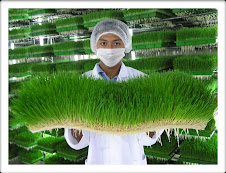
I've been asked many times how different this wheatgrass product that I endorse versus the many options available in the market today. Aside from the fact that it is very convenient to take, tastes relatively well, and costs less per drink, it really is more nutritious due to its inclusion of the roots. This is made possible through its patented Indoor Organic Aeroponic Cultivation (IOAC) technology.

Read on ...

Indoor Organic Aeroponic Cultivation (IOAC)


IOAC is patented, award-winning cultivation method recognized in Malaysia and Geneve, Switzerland. In this cultivation method, wheatgrass is grown indoors in a fully automated and sterile laboratory. This allows us to have full control over the moisture, temperature and indoor growing environment of the wheatgrass to ensure optimal growing conditions. Aeroponic farming means that our wheatgrass is grown in the air without the use of soil or water as a base as in traditional farming or hydroponics. This allows the roots to grow and stay sterile making it possible for the company to process and include the roots of wheatgrass in every sachet of wheatgrass powder. All essential minerals and nutrients that the regular wheatgrass absorbes from the soil, is mixed with the water that is misted evenly on to the farm 8 times every day to ensure that each tray of wheatgrass gets equal amounts of moisture and nutrients. Artificial sunlight is provided by special lights that simulate the same lighting properties as natural sunlight.


Aeroponic farming is also employed in IOAC to intentionally subject the wheatgrass to stress from the absence of soil and low temperatures maintained in the farm. These conditions force the plant to produce ABSCISSIC ACID which is an essential enzyme that is highly effective in fighting cancer cells or can help prevent cancer formation. This plant hormone turned enzyme can only be found in the most amounts in Easy Pha-max Wheatgrass.


One pound of fresh Easy Pha-max wheatgrass with leaves and roots goes into every 2g sachet of wheatgrass powder. This is the most amount of fresh wheatgrass per serving that you will find anywhere in the market. The fresh wheatrgass is dried and processed through centrifugation and turned into a fine powder for ease of consumption and the convenience of our consumers. No other product matches this amount on a per peso basis. Don't be fooled 8-)


To Your Good Health,

Wheatgrass Man


Monday, November 2, 2009

Why Going Vegetarian Supports the Environment


Dear Readers,

I'd like to share this article from Hewo.Com. It is a very relevant topic as Global Warming is becoming a major agenda in governments worldwide. And with upcoming movies like 2012, this is REALLY a becoming a serious issue.

I am not a vegetarian, well not just yet. But I try as much as possible to avoid meat to the best of my abilities. I believe this has helped me a lot in my quest for good health.

Read on ...


"Since Al Gore’s An Inconvenient Truth short documentary movie came out in 2006, it has awakened people to the alarming Earthly facts, especially the hot cake topics surrounding global warming. We talk about industrial pollutions, drastic changes of weather patterns, deforestation and a whole lot more of big scale issues. But, there could be one issue that people might have overlooked. And that is meat consumption.


“Why? Meat does not look “polluting” enough to me. Are you being serious that if I continue eating hamburgers, chicken drumsticks and juicy sirloin steaks, I would actually be polluting Earth? I think you are preaching your religion of eating spinach to me.”

People can be sceptical when presented about how meat consumption should be reduced to tackle global warming. And you must be wondering why eating meat could cause damage to our Mother Earth.


The meaty effects


First of all, meat industry emits more greenhouse gas than any factor given. According to the United Nations, total amount of greenhouse gas emitted by livestock farms and meat-processing factory is around 18% of the total greenhouse gases emitted into the atmosphere, making it the largest single factor in causing greenhouse gas.


Second, meat production takes more resources than growing vegetables and fruits. Growing meat is never efficient. We need 16 times as much grains to produce meat, and we need another 16 times as much resources as to produce these grains to feed our cows, lambs, goats and chickens. Around 70% our grown vegetations are being used to feed livestock, just for them to produce enough meat for us. Besides that, we also need to put in power to refrigerate our meat, to process them, and to ship them throughout the world.


Third, we need enormous water supply to produce meat. According to a statistic made by John Robbins in his book Food Revolution, we need 99.6% lesser water to grow one pound of potatoes, than to grow one pound of beef, and 97% lesser water than to grow one pound of chicken. Aside from supplying water to livestock as their drinking water, we need to constantly wash them, clean up their cages from accumulating faecal wastes, as well as to clean up the mess after we butchered them. To be specific, it takes 5214 gallons of water (or about 19731 litres) to produce one pound of beef.


Last but not least, eating meat cuts more land. In fact, raising animals for food takes up more land than to grow crops directly. We need 16 pounds of grains to produce 1 pound of beef. This means in order to grow beef, we need 94% more land to cultivate grains for them, and more land needed means more pesticides needed. Instead of producing food for us, they are more like processing food for us, in a reverse way. According to a recent study by PETA.org, more than 90% of Amazon rain forest was cleared since 1970 is used for global meat production.


To be green, we don’t have to sweat. We just need to change what we eat, because what we eat determines how we get it, and how we get it determines what kind of effects our surroundings will get. You can keep earth green by simply not eating any animals.


Quit meat! It’s not just good for your body; it’s good also for your earth."